14. Cell Division and the Cell Cycle (1,107)
- lscole
- Apr 28, 2025
- 5 min read
Updated: Jun 27
Every day, your body replaces hundreds of billions of cells. Each must first copy over three billion letters of DNA and, once that's done, divide its contents with extraordinary precision.
The importance and rate of cell division vary dramatically between different cell types. Some tissues--like bone marrow, the lining of the gut, the skin, and hair follicles--are constantly turning over. Their cells divide continuously to replace onesc lost to wear. Other cell types divide rarely or not at all.
There is also a developmental dimension to cell division. Not surprising, during embryonic development, cells divide rapidly. By birth, the human body contains about one trillion cells, meaning at least that many divisions have occurred to build a human body from a single fertilized egg. And after birth, cell division is more frequent during infancy and childhood than in adulthood.
All this cell growth and renewal depends on a single recurring process: the cell cycle. The cell cycle is not just a sequence of stages. It’s a progression of commitments. At each stage, the cell makes a decision that commits it to the next step, often irreversibly once key checkpoints are passed.
The cell cycle
The cell cycle has one purpose: to prepare for and execute genome replication and cell division. For many human cells it takes roughly 24 hours, though the timing varies. Those 24 or so hours are divided into four phases in the following order:
G1 (growth 1): the cell decides whether to divide
S (synthesis): the cell copies its genome
G2 (growth 2): the cell confirms everything is ready for division
M (mitosis): the cell divides
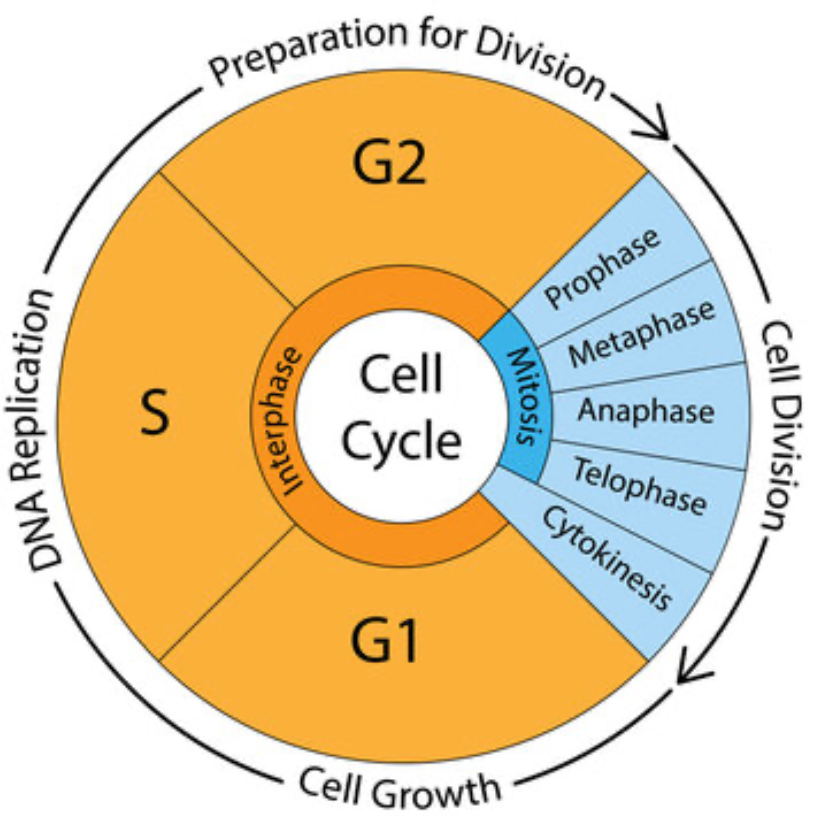
Cells that aren't actively dividing but just doing their jobs are described as being in G0 (G zero). G0 is not part of the cell cycle. But a cell in G0 can enter the cell cycle at G1 if stimulated by growth signals from the surrounding tissue.
Of the four phases of the actual cell cycle, the S and M phases are primary--they deliver the two outputs of the cell cycle: genome replication and cell division, respectively. S phase (synthesis) is one of the most dangerous tasks a cell performs. A single error can propagate through all future cells. M phase (mitosis) consists of highly choreographed steps. We'll discuss these in the next chapter.
The other two phases, G1 and G2, are focused on, respectively, committing to and preparing for S phase, and confirming that the cell is ready to divide in M phase.
During G1 the cell grows and assembles the machinery for DNA replication. At the end of G1 there is a cell cycle checkpoint; the G1/S checkpoint. At this checkpoint the cell determines whether it should commit to another round of division.
Following S phase, the cell enters G2 where it prepares for division, or M phase. To do so it produces additional organelles and other cellular components to fill the two daughter cells.
Another checkpoint occurs at the end of G2: the G2/M checkpoint. Here the cell checks that the DNA copied during S phase is complete and free of major damage and that the cell is ready for mitosis, or cell division.
One more thing: After M phase there is a short phase called cytokinesis during which the cell pinches itself off completely at its midpoint to become the two new daughter cells.
After cytokinesis, the daughter cell enters G1. From there it may proceed through another round of the cell cycle or exit into G0, where it can carry out its specialized function(s) without dividing.
Regulating the cell cycle
The cell doesn’t use a central clock. It keeps time through a sequence of molecular triggers. At each new phase of the cell cycle, new sets of genes are turned on and others turned off to accomplish the tasks of that phase.
This turning on and off of the appropriate genes is spearheaded by members of two protein families that work as partners: the CDK (cyclin-dependent kinases) family of enzymes and the cyclin family of regulatory proteins.
A CDK is a class of enzyme called a kinase that uses an ATP molecule to transfer a phosphate to a specific amino acid on a protein. The placement must be precise.
Kinase-attached phosphate groups change protein behavior. They can identify, or flag, a protein as a target for an action by another protein. They can also change the conformation (shape) of the protein to activate it, deactivate it, or alter its function. Kinase-attached phosphates are powerful molecular switches with different purposes depending on the protein, where it is attached, and the cellular context.
Members of the CDK family are present in the nucleus all the time but remain inactive unless bound to a partner cyclin. They're like machines wandering around waiting for the right key.
The expression of different cyclins drives different phases of the cell cycle. When a particular cyclin is expressed, it binds to a specific partner CDK and switches it on. Being a kinase, the activated CDK then phosphorylates many other target proteins, triggering the events required for that phase of the cycle.
As one phase ends, its associated cyclin is destroyed and replaced by another, activating a new set of CDKs and moving the cell forward through the cycle. An example will give you the flavor.
We'll begin at the start of G1 phase. Cyclin D is expressed and attaches to and activates two partner CDKs: CDK4 and CDK6. These two now-activated CDKs drive the gene expression pattern required in G1.
As the cell approaches the transition to S phase, cyclin E takes over, attaching to and activating CDK2, which prepares the cell to copy its genome. During S phase, cyclin A attaches to CDK2. This drives DNA replication. Later, in G2 and M phase, cyclin A and cyclin B activate CDK1. This carries the cell through mitosis and prepares it for cytokinesis.
No single molecule oversees this process. Instead, each step triggers the next.
The rollout of these cyclins must be precise because genome copying and cell division are two of the most dangerous things a cell does. Nearly every major failure of cell regulation, including many forms of cancer, traces back to mistakes made in replication and cell division.
And yet, this process unfolds reliably, again and again--not because a central system directs it, but because each step triggers the next.
In the next chapter, we’ll look closely at mitosis--where the coordination becomes visible as chromosomes are pulled apart with amazing precision.
(1) Scientific American, April 1, 2001, Our Bodies Replace Billions of Cells Every Day. https://www.scientificamerican.com/article/our-bodies-replace-billions-of-cells-every-day/?utm_source=chatgpt.com
(2) Bionumbers. Accessed 1-15-2025. https://bionumbers.hms.harvard.edu/bionumber.aspx?id=106413&ver=4&utm_source=chatgpt.com


Comments